Introduction: Your Business Cannot Always Answer, But It Can Still Respond
An AI phone answering service for small business is not about replacing real people.
It is about protecting real opportunities.
Because small businesses miss calls.
That is normal.
You might be helping a customer.
You might be on another call.
You might be driving.
You might be closed for the day.
Your team might be short-staffed.
You might be doing the actual work customers are calling you for.
That is the reality of running a business.
The problem is that customers do not always wait for reality to calm down.
They call when they are ready.
They call when they have a question.
They call when they need help.
They call when they are comparing options.
They call when the problem is fresh.
If nobody answers, that lead can disappear.
That is where an AI phone answering service can help.
Used correctly, it can answer basic questions, capture caller details, route inquiries, book appointments, send follow-up messages, and make sure your business does not feel unreachable just because nobody could grab the phone at that exact second.
This is especially useful for small businesses where every call can matter.
Think about:
- Dental offices
- Salons and barbershops
- Contractors
- Restaurants
- Gyms and fitness studios
- Real estate agents
- Law firms
- Repair services
- Medical and wellness offices
- Home service businesses
- Local retailers
- Auto shops
A missed call in these businesses is not always casual.
Sometimes it is revenue trying to walk in through the phone.
And revenue is rude like that.
It does not always wait politely.
This article breaks down:
- What an AI phone answering service does
- How it helps small businesses capture missed leads
- Where AI voice agents fit into the customer experience
- What businesses should automate and what they should not
- Why compliance and consent still matter
- How to decide if your business needs AI call handling
- How CLIK Creatives can build the system for you
Because the goal is not to sound futuristic.
The goal is to stop losing customers just because your phone rang at the wrong time.
Quick Answer: What Is an AI Phone Answering Service for Small Business?
An AI phone answering service for small business is a phone system that uses AI voice technology to answer calls, collect customer information, answer basic questions, route inquiries, book appointments, and trigger follow-up workflows.
It helps businesses stay responsive when staff cannot answer live.
What an AI Phone Answering Service Actually Does
An AI phone answering service acts like a front-line call assistant.
Depending on how it is built, it can:
- Answer incoming calls
- Greet callers professionally
- Ask what the customer needs
- Answer common questions
- Collect name, phone number, email, and service interest
- Check availability or booking options
- Schedule appointments
- Route urgent calls
- Send call summaries to staff
- Add leads to a CRM
- Trigger SMS or email follow-up
- Help after hours
That does not mean the AI should handle everything.
It should not try to replace every human conversation.
It should handle the repeatable front-end work that keeps leads from getting lost.
For example:
A customer calls after hours to ask about availability.
The AI can answer, collect details, and offer a booking option.
A customer calls during the day while staff is busy.
The AI can capture the request and notify the team.
A caller asks a basic question about services.
The AI can provide approved information and guide the caller to the next step.
That is useful.
But if a customer has a sensitive issue, a complex situation, a complaint, or something that requires judgment, the system should know when to route or escalate.
Good AI call handling is not about pretending robots know everything.
It is about designing the right handoff.
Why Small Businesses Are Looking at AI Call Answering
Small businesses are stretched.
They need to be responsive, but they do not always have a full-time receptionist, call center, or admin team.
That creates a gap.
The business wants to serve people well.
But the phone rings while the owner is doing five other jobs.
That is where AI call answering becomes interesting.
It can help with:
- After-hours coverage
- Missed call capture
- Appointment booking
- Basic FAQs
- Lead qualification
- Call routing
- Follow-up reminders
- CRM updates
This is not just about convenience.
It is about speed and consistency.
Customers are used to fast responses.
They expect businesses to be reachable.
They may not care that you are short-staffed, in the middle of a job, or finally eating lunch over the sink like a raccoon with responsibilities.
They care whether their question gets answered.
AI call handling can help you respond without forcing your team to live in panic mode.
AI Phone Answering vs. Voicemail
Voicemail is passive.
AI answering is active.
That is the key difference.
Voicemail says:
“Leave a message, and maybe someone will call you back.”
An AI answering service can say:
“Thanks for calling. I can help collect your information, answer a few questions, and help you schedule the next step.”
That is a very different experience.
Voicemail depends on the customer doing extra work.
AI can guide the customer through the next step.
Voicemail stores a message.
AI can structure the information.
Voicemail waits.
AI can trigger follow-up.
Voicemail often feels like a dead end.
AI can feel like the business is still present.
That does not mean voicemail is useless.
It just means voicemail should not be your only backup plan.
Where AI Phone Answering Helps Most
An AI phone answering service is most useful when your calls are repeatable, time-sensitive, or easy to route.
Appointment-Based Businesses
Dental offices, salons, clinics, gyms, studios, and consultants can use AI answering to capture appointment requests, answer basic scheduling questions, and push callers toward booking.
Service Businesses
Contractors, repair companies, cleaning services, landscapers, plumbers, electricians, and other local service providers can use AI to collect job details, location, urgency, and preferred times.
Restaurants and Hospitality
Restaurants, event spaces, cafes, and hospitality businesses can use AI for hours, directions, reservation questions, menu questions, event inquiries, and basic routing.
Real Estate and Legal
Real estate agents and law firms can use AI to capture inquiry details, qualify leads, and route urgent or sensitive matters to the right person.
For industries with legal, medical, or financial sensitivity, the system should be carefully designed with approved responses and human escalation.
AI should not wander into advice territory wearing a fake expert badge.
What AI Should and Should Not Handle
This is important.
Not every call should be handled by AI from start to finish.
A good AI phone system has boundaries.
AI Can Handle
AI can help with:
- Greetings
- Business hours
- Location information
- Service categories
- Basic pricing ranges when approved
- Appointment requests
- Intake questions
- Lead qualification
- Call routing
- FAQ responses
- After-hours capture
- CRM updates
- Follow-up triggers
AI Should Not Fully Handle
AI should not fully handle:
- Complex complaints
- Sensitive medical details
- Legal advice
- Financial advice
- Emergency situations
- Heated customer disputes
- Highly customized quotes
- Anything requiring human judgment
The best setup is not “AI does everything.”
The best setup is “AI handles the first layer and knows when to hand off.”
That keeps the experience useful instead of weird.
Compliance Still Matters With AI Calls and Texts
AI call systems can be powerful, but businesses still need to think about consent, call rules, and texting compliance.
The FCC’s TCPA guidance explains that certain automated calls and texts require consent. The FTC’s Do Not Call guidance explains how the National Do Not Call Registry applies to telemarketing.
For SMS follow-up, Twilio’s U.S. SMS compliance guide is a useful resource for understanding opt-in, opt-out, and consent expectations.
The simple version:
Use AI to improve service.
Do not use it to annoy people.
Inbound calls, appointment reminders, customer service responses, and requested follow-ups are very different from blasting promotional messages to people who did not ask for them.
If your AI phone system includes SMS, it should use clear opt-in language, honor opt-outs, and avoid sending messages that feel sneaky or unwanted.
Trust is the whole point.
Do not use automation in a way that makes customers regret giving you their number.
How AI Phone Answering Connects to Your Larger System
An AI phone answering service works best when it is connected to the rest of your business.
If the AI answers a call but the information goes nowhere, that is not a system.
That is just a fancy voicemail with better posture.
A strong setup should connect to:
- Your CRM
- Your calendar
- Your website forms
- Your email system
- Your SMS follow-up
- Your sales pipeline
- Your review system
- Your internal notifications
For example:
A customer calls after hours.
The AI answers.
It collects their name, phone number, service need, and preferred time.
It offers a booking link.
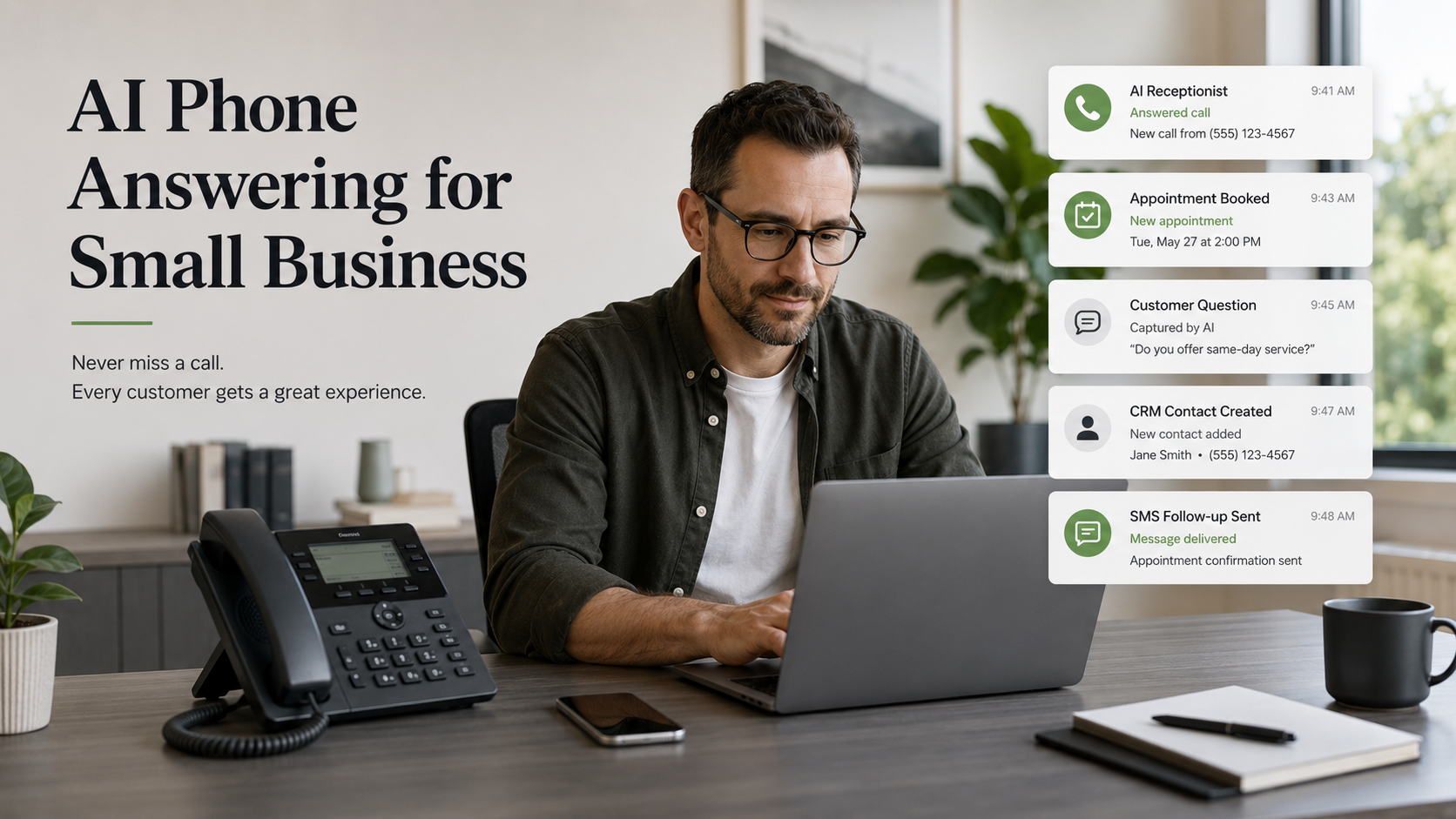
It creates a CRM contact.
It sends the business a call summary.
It sends the customer a confirmation text.
It creates a follow-up task for the next morning.
That is a system.
Now compare that to:
A customer calls.
The phone rings.
Nobody answers.
They hang up.
That is a leak.
The difference is not just AI.
The difference is workflow.
Why Google Business Profile Still Matters
Many local calls start from Google Search or Maps.
That means your Google Business Profile still plays an important role in call volume.
Google’s Business Profile support page explains that businesses can use a profile to connect with customers, post updates, list products and services, share menus, and more.
But your Google profile is not a complete call management system.
Google Business Profile chat and call history are no longer available as of July 31, 2024, according to Google’s official Business Profile support update.
That means businesses need their own system for missed calls, follow-up, and lead tracking.
Your Google profile helps customers find you.
Your AI answering and CRM system help make sure that interest is captured.
Both matter.
What to Look for in an AI Phone Answering Service
Not every AI phone answering setup is equal.
Before using one, ask these questions.
Can It Answer Like Your Business?
The system should use your approved language, services, tone, and process.
It should not sound like a random robot got hired off a clipboard.
Can It Capture the Right Information?
Your AI should collect the details your team actually needs.
That may include:
- Caller name
- Phone number
- Service needed
- Location
- Preferred time
- Urgency
- Notes
- Booking request
The goal is useful information, not a messy transcript nobody reads.
Can It Connect to Your CRM?
This is big.
If call details do not enter your CRM or pipeline, your team may still lose the lead.
The AI should support your follow-up process.
Can It Book Appointments?
For appointment-based businesses, booking can be a major win.
The system should connect to a calendar or send the customer toward a booking step.
Can It Escalate to a Human?
AI should not trap people.
If the customer needs a person, the system should route or notify someone.
Can It Support Compliance?
If the system sends texts or makes outbound calls, it should support consent, opt-out handling, and proper messaging practices.
Can It Be Updated?
Your business changes.
Your AI script, FAQs, services, and routing should be easy to update.
A stale AI system becomes the new outdated website.
Different outfit, same problem.
Tools That Can Help You Build the System
Tools are not the strategy.
But the right tools can make the strategy easier to manage.
A platform like GoHighLevel can help connect phone numbers, CRM pipelines, calendars, missed call text-back, SMS, email follow-up, and automation workflows.
That makes it a strong option for businesses that want their AI phone answering system connected to lead management instead of floating by itself.
If you also need supporting assets for landing pages, lead magnets, graphics, or social content around your phone and booking system, Envato Elements can help with templates, design assets, and video resources.
But remember this.
The tool is not the win.
The workflow is the win.
An AI phone tool without a clear script, CRM process, routing logic, and follow-up plan is just expensive noise with a greeting message.
How to Start With AI Phone Answering
You do not need to automate every call on day one.
Start with the biggest gap.
Step 1: Identify Your Missed Call Problem
Look at your call log.
When are calls missed?
During business hours?
After hours?
Weekends?
Lunch breaks?
Busy service windows?
Find the pattern.
Step 2: List Your Common Call Types
Write down what people usually call about.
Examples:
- Hours
- Pricing
- Availability
- Booking
- Services
- Directions
- Emergencies
- Product questions
- Appointment changes
- New customer inquiries
This becomes the foundation for your AI script.
Step 3: Decide What AI Should Handle
Choose the simple, repeatable tasks first.
Do not start with complicated edge cases.
Let AI handle the front door.
Let humans handle judgment.
Step 4: Create Approved Responses
Write clear answers for common questions.
Keep them simple.
Use plain language.
Avoid overpromising.
Step 5: Connect Follow-Up
Make sure every important call creates a next step.
That may be:
- CRM contact
- Calendar booking
- Staff notification
- Follow-up task
- Confirmation text
- Email sequence
The AI should not just talk.
It should help move the lead forward.
The Better Way to Think About AI Phone Answering
AI phone answering is not about replacing customer service.
It is about protecting customer intent.
When someone calls your business, they are giving you attention.
Attention is valuable.
A weak phone system wastes that attention.
A good AI phone system captures it, organizes it, and sends it to the right place.
That is the point.
Not to sound futuristic.
Not to brag that your business has AI.
Not to build a robot receptionist that talks too much and scares people.
The point is to make your business easier to reach.
Easy wins.
Especially in local business.
Build a Phone System That Does Not Let Leads Disappear
If your business depends on phone calls, then your phone process deserves a system.
The DIY route is possible.
You can audit your calls, write basic scripts, set up missed call text-back, connect a CRM, and use tools like GoHighLevel to support call capture, booking, and follow-up.
But if you do not want to build the whole thing yourself, CLIK Creatives can build a done-for-you AI phone answering and lead follow-up system around your business.
That can include:
- AI phone answering setup
- Missed call text-back
- CRM pipeline setup
- Calendar and booking integration
- SMS and email follow-up
- After-hours call capture
- Lead routing
- Call summary notifications
- Review request workflows
- Website and Google profile connection
- Approved scripts and response flows
You do not need to be available every second to stop losing leads.
You need a system that helps customers feel answered, captured, and guided to the next step.
If your phone is ringing but your follow-up feels scattered, CLIK Creatives can help turn your call process into a calmer, smarter lead capture system.
FAQ
What is an AI phone answering service for small business?
An AI phone answering service uses AI voice technology to answer calls, collect caller details, answer common questions, route inquiries, and support booking or follow-up.
Is AI phone answering the same as voicemail?
No. Voicemail stores a message. AI phone answering can interact with the caller, ask questions, collect information, trigger workflows, and guide the next step.
Can AI answer calls after hours?
Yes. AI phone answering can help capture after-hours calls, answer approved questions, collect lead details, and notify the business for follow-up.
Can AI book appointments?
Yes, if the system is connected to a calendar or booking workflow. This is especially useful for appointment-based businesses.
Is AI phone answering good for small businesses?
Yes, especially for businesses that miss calls, rely on appointments, handle repeat questions, or need better after-hours lead capture.
What should AI not handle?
AI should not fully handle complex complaints, legal advice, medical advice, financial advice, emergencies, or situations requiring human judgment.
Is AI phone answering legal?
AI phone answering can be used legally, but businesses should understand call, SMS, consent, and telemarketing rules. FCC, FTC, and SMS compliance resources are useful starting points.
Does my business still need a real person?
Yes. AI should support your team, not replace human judgment. The best systems use AI for repeatable front-end tasks and humans for complex situations.
What tools can help with AI phone answering?
Platforms like GoHighLevel can help connect phone numbers, CRM pipelines, missed call text-back, calendars, SMS, email, and automation workflows.
Can CLIK Creatives build an AI phone answering system?
Yes. CLIK Creatives can build a done-for-you AI phone answering and follow-up system that connects calls, CRM, booking, SMS, email, and lead capture.
2026 Refresh: AI Phone Answering Works Best as a Response System
The value of AI phone answering is not the novelty of having a bot answer the phone. The value is reducing the gap between customer intent and business response.
For a small business, the system should capture the caller?s reason, collect the right contact information, route the request, start the next step, and create a clear human handoff when the conversation needs judgment.
What to build into the system
- Call reason capture: booking, pricing, service question, complaint, emergency, or follow-up.
- Owner or staff notifications for high-value or sensitive calls.
- CRM logging so the lead is not trapped in a call transcript.
- Retry and fallback behavior when the caller does not complete the flow.
- Opt-out and escalation paths for people who want a human.
CLIK system tie-in: AI phone answering belongs inside a Lead Capture and Follow-Up System or AI Concierge and Front Desk System, not as a disconnected phone feature.
Related reading: How Missed Calls Cost Businesses Money and Modern Marketing Strategy for Small Business.